


Moon Active Takes Aim; Why casual giants now hunt for hypercasual cores
Writer's Note: The last article that was published here covered Monopoly Go was eating the world. Plenty has happened while I was at Supercell (sorry for the radio silence!) but this recent development pulled me right back to the keyboard: The hybridcasual puzzle craze.
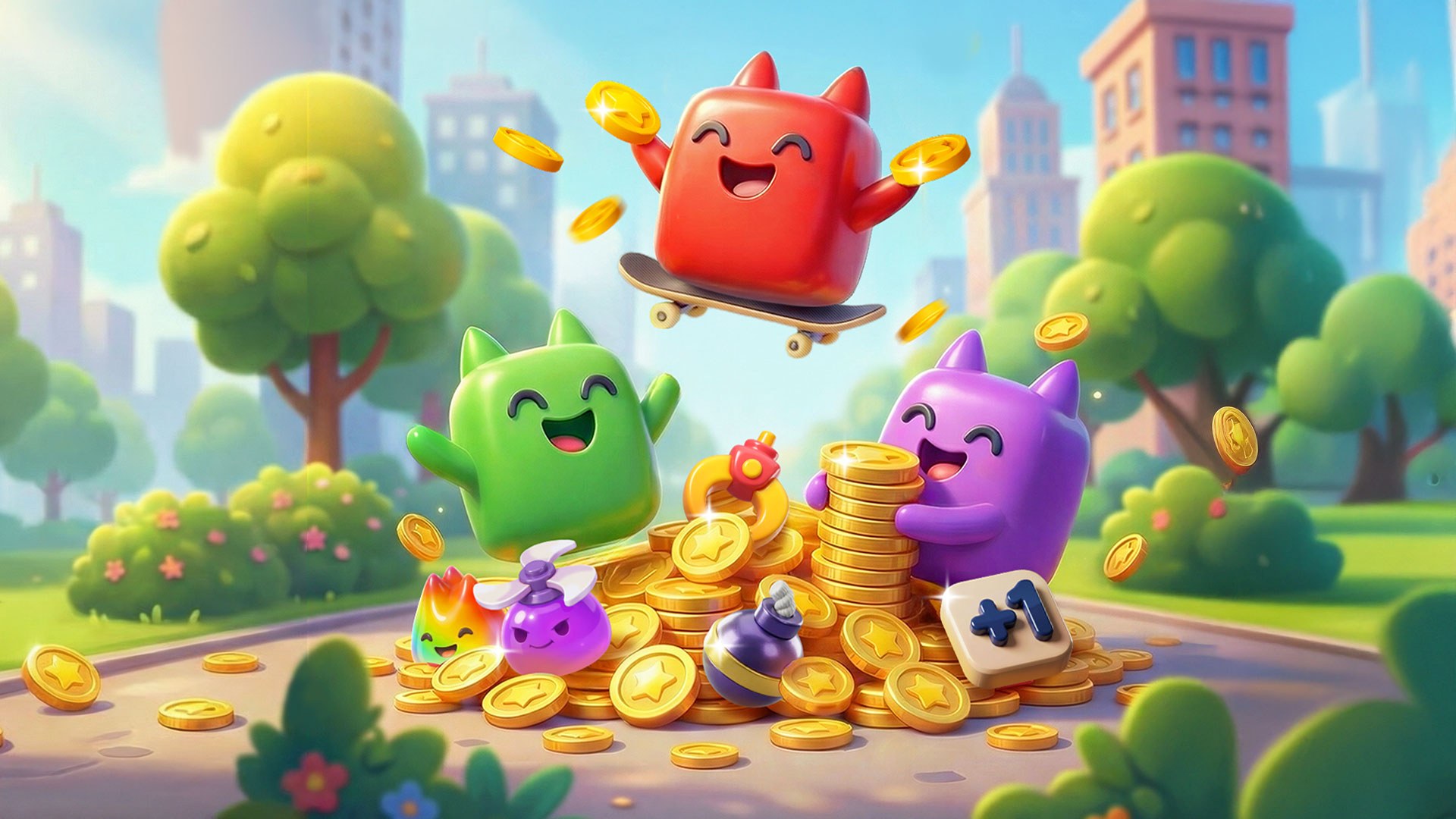
An especially fitting use case for this phenomenon is Moon Active's push into this genre. The company that made billions with a slot machine and a thieving pig is now shipping jelly cubes, black holes, cannons and reef fish.

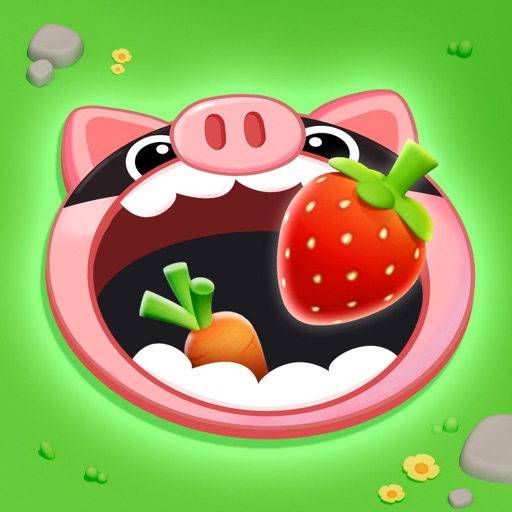
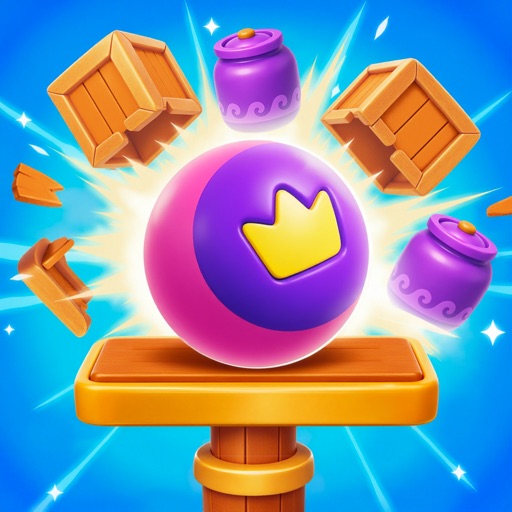
Four bets are live or in soft launch, each one a fast follow of a fresh puzzle wave. Together they're still a small slice of Moon Active's IAP revenue, but a fast-growing one: 12.6% in October 2026, up from 0.4% in January. So rather than just listing the games, let's answer the more interesting question: why is a casual giant like Moon Active, and frankly the whole casual industry, going hypercasual-core shopping right now?
As can be seen above: Coin Master now earns just a bit more than half of Moon Active's revenue. What changed is the cost of a player.
Same Company, Different Puzzle


Let's be clear: Moon Active is no stranger to puzzle. Zen Match (tile match) and Travel Town (merge-2) have been portfolio pillars for years, and that pipeline hasn't stopped: Dream Bay, a renovation-themed merge game, has been in soft launch since September. So the hybridcasual line is an extra lane, not a pivot. What's new is the kind of puzzle: short, hypercasual-born cores, lifted from whatever wave is topping the charts that quarter. Here are the four, with what the data shows on each:
| Game | Riding the wave of | Status & numbers |
|---|---|---|
| Jelly Busters | Pixel Flow (Loom Games, Istanbul) | Released Jan 2026. Took 144 days to its first $1M, then made $5.8M in the 30 days before early November. #9 hybridcasual puzzle in Q3 2026 with $12.4M |
| Hole Stars | All in Hole (Homa) | Global July 2025. $9.0M IAP in Q3 2026, #2 in Eat & Grow, right under Homa. |
| Splash Kingdom | Smash Fest / Toon Blast's Cannon Fest | Soft launch in early summer, then a second test in India and Israel on iOS and Android (Google Play lists it as Royal Splash: Tower Blast). Under 6K downloads in its best month so far |
| Reef Busters | Pixel Flow's "eat the image" spin-off | Soft launch since April 2026 in Israel, Austria, France and more of Europe, fish theme. Live two months before Colony Flow made the ant version a hit |
Two of the four share a naming scheme (Jelly Busters, Reef Busters), which tells you this is a product line rather than a series of experiments. And it sits next to a second expansion axis: the Coin Master franchise itself, which went into a board game with Coin Master - Board Adventure in early 2026. As AppMagic noted at the time, Moon Active isn't alone here; Good Job Games is stretching Match Villains into a Police Escape spin-off that's far closer to hypercasual than the original.
One monetisation layer, many cores


Coincidence? I think not! None of this should surprise anyone who has followed Moon Active's playbook. Naavik called it "Moon Active's Quiet Dominance" back in 2024: acquire (or build) a working casual core, then add Coin Master's monetisation layer on top: meta progression, events, personalised offers and a live-ops calendar. Travel Town, Family Island and Zen Match all became top-3 earners in their subgenres after that change. Travel Town made $117M in 2024 up to September, up 231% year on year, after Moon Active bought it in 2022 and pointed its UA war chest at it.
As our Board Kings article back showed back in 2019, Coin Master didn't invent its genre either. Playtika owned both originals (Pirate Kings and Board Kings), yet the billions went to the followers who swapped the core action for a slot machine. Moon Active has never been in the business of inventing cores. It's in the business of monetising them.
Follow the price tags
So what changed? Moon Active already knows how to grow casual puzzle games: Travel Town, Zen Match and Family Island prove that. Why would a company with that track record add short, hypercasual-born cores that rise and fade with each chart wave? There are three reasons, all landing at the same time.
1. Installs got too expensive
Traditional Casual puzzle is mature; no news there. But "mature" undersells it. During an episode of DoF's TWIG, Miska puts the bill for a serious attempt at mobile puzzle at $25 CPIs, paybacks beyond 12 months, and therefore roughly $100M minimum just to give it a go. And because so many studios ship games that look like Royal Match, they all bid on the same players at the same brutal $25+ CPIs.
The result? In H1 2026, only 1 out of 120 new match-3 games reached $100K in monthly revenue even once.
Puzzle still grows, passing $8.2B IAP in 2025 (+7.6%), but AppMagic notes the growth concentrates in big studios applying proven playbooks to new titles. Moon Active's own home turf shows the same squeeze: in coin looters, revenue per download slipped from about $29 in 2024 to $27 in H1 2025 as challengers fragmented downloads.
That's a market where LTV is maxed out and CPI keeps climbing. You can live-ops your way out of that equation for a while, but like anything in game dev: not forever.
2. Turkish taxpayers fund the industry's R&D
This is the part that everybody talks about, yet hardly anyone connects to game design. Let's line up the numbers:
- Capital: one exit (Peak to Zynga, 2020) kicked off a flywheel: 65 startups spun out of the same early studios, repeat founders became angels, and at least 25 VC funds now invest in Turkish game startups. Turkish mobile studios raised around $400M between January 2025 and mid-October 2026, close to 40% of the global total.
- Subsidies: Turkey's 2026 programme refunds up to 50% of UA, store fees and cloud costs, up to 70% for UA in the US and UK, within annual caps. DoF's summary: a Turkish studio effectively pays $0.30 for every dollar of US UA a competitor pays in full.
- Tax: technopark publishers pay 0% profit tax through 2028. On the same $20M game, Matthew Emery's model has a Western publisher keeping $2.4M versus $4.2M in Istanbul.
- Cost of trying: ten hybridcasual prototypes with a $15K UA test each cost about $1.15M at an average Western studio versus about $360K in Istanbul (same post).
That's not a head start, that's a different starting line. Turkish publishers went from 1.0% of worldwide mobile game IAP in 2019 to 5.8% in 2026 so far, passing Israel and South Korea to rank fourth behind China, the US and Japan. And notice what they spend that cheap money on. Not 4X. Not shooters. Hybridcasual puzzle: Loom Games' Pixel Flow (sold to Scopely at a $1B+ valuation within months), Grand Games' Magic Sort and Block Out, Good Job's Police Escape. 2.5 Gamers calls Istanbul "the university of puzzles": local investors want puzzle, and founders learn level design inside studios like Dream Games before going solo. In AppMagic's Q3 2026 hybridcasual puzzle chart, Istanbul studios hold the top three spots: Pixel Flow, then Grand Games' Block Out and Magic Sort. Grand Games told DoF it hit a $500M run rate in about two years by deliberately not fighting Dream Games for the match-3 crown. That's the company's own figure, and most likely gross bookings including ads and web-shop sales: store estimates of its net IAP came to about $59M in Q3 2026, or roughly $340M a year before the app stores take their cut.
Now put yourself in Moon Active's shoes. A competitor that pays 30 cents on the dollar for installs can outbid you in any auction it enters, and that cost structure can't be copied from Tel Aviv. But winning the prototyping race isn't necessary. With testing this cheap, Istanbul runs the lottery for the whole industry, and the winning tickets are public: Pixel Flow and Smash Fest, two of the waves Moon Active is riding, both came out of Istanbul. What those studios are less good at is keeping a hit alive. Thin-meta hits fade fast, and even Grand Games' CEO admits live-ops optimisation is its weak spot. That's the battlefield where a fast follower with a deeper monetisation layer can win. Turkey finds the cores. Moon Active's job is to out-operate them.
3. Casual giants join the club
All the way back in 2020, we covered hybridcasual as mobile's most exclusive members club. Fighting for hypercasual-level CPIs while still rocking the highest possible LTV has been the holy grail ever since. What changed in 2026 is who's chasing it.
- 2019Archero landsHabby's May launch pairs a one-thumb arcade core with RPG progression. Abhimanyu Kumar and Miska Katkoff coin the term "hybridcasual" for what follows.
- 2020Joining Mobile's Most Exclusive Members ClubLudociousHybridcasual means an arcade core with a deep meta. Puzzle is listed among the genres that don't fit. (woops!)
- 2021ATT breaks hypercasualApple's App Tracking Transparency arrives in April. Ad-only economics get harder, and the big hypercasual publishers start adding IAP and meta.
- 2022Survivor.io goes globalHabby's August launch turns hybridcasual from an experiment into a top-grossing genre.
- 2023The Evolution of HybridcasualLudociousVoodoo, Homa, SayGames and Habby settle on a playbook: power progression, a real free-to-play economy and live ops on top of an arcade core.
- 2025Puzzle joins after allIstanbul turns hypercasual-born puzzle cores into IAP hits, with Loom Games' Pixel Flow as the breakout.
- 2026The casual giants move inYou are hereMoon Active, Playrix and Dream Games bring casual-scale monetisation and UA budgets to the same playbook.
The new members come from the other side: big established casual game companies that already own the best monetisation layers in mobile, and are now moving them onto cheaper cores or opening their own games up to ads:
- Moon Active's whole history is moving similar monetisation layers between different cores.
- Playrix runs Township as what 2.5 Gamers called a "reverse 4X": the 17-year-old tycoon loop barely gets features anymore and works as the cheap, ad-facing way in, while match-3 behind it does the monetising. Township hit an all-time high of around $45M a month in March 2026.
- Even Dream Games, whose marketing pillar was "no ads", added interstitials and rewarded video to Royal Kingdom in early 2026, which allowed blended IAP-plus-ads ROAS campaigns. Downloads hit an all-time high of about 600K a day, with Brazil going from roughly 12-25K to over 150K a day.
Pair those with cores that sell themselves in 15 seconds of honest gameplay footage, and the hybridcasual formula finally runs at casual scale.
Seen from that angle, Jelly Busters isn't a side quest. It's Moon Active applying the one thing it's world-class at (monetisation) to the one thing it was missing (cheap installs).
Moon's scorecard so far
Jelly Busters is the success story. $5.8M in 30 days is more than most 2026 RPG launches manage, and puzzle games that pass $1M have a median lifetime revenue of $4.3M, the highest of any genre. Puzzle is slow to start but plays the long game, which fits a live-ops-specialised company like a glove. And Moon Active's monetisation shows up exactly where you'd expect it: in Q3 2026 Jelly Busters made $12.4M on just 2.3M downloads, about $5.40 of IAP per install. That's level with Pixel Flow (~$5.60) and roughly four times Colony Flow (~$1.40). Same core, far higher LTV.
Hole Stars is the slow burner. By June 2026 it had made $3.7M lifetime against All in Hole's ~$120M, and AppMagic's verdict on Moon Active and Supersonic was that they weren't able to get closer to the original.
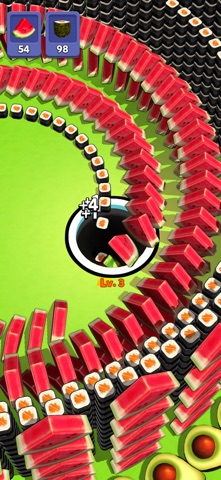
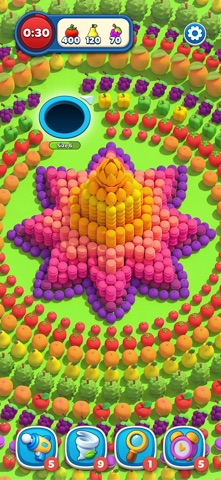
One quarter later the picture looks very different: in Q3 2026 Hole Stars made $9.0M against All in Hole's $19.8M, half the leader's run rate, and AppMagic now credits the two followers with reigniting a niche that had started to stagnate. On a lifetime basis it's still 2021's Merge Mayhem: the first game to scale buys its audience at pre-inflation CPIs, and followers rarely close a lifetime lead built that way. In terms of run rate, though, Moon Active is closing the gap. And it wasn't even the strongest follower at first: Supersonic's Hole It 3D out-earned Hole Stars every month until June 2026. The niche keeps drawing casual companies, too: Tactile, the studio behind Lily's Garden, launched its own hole game, Suck It Up, which 2.5 Gamers estimated at about $30K a day in IAP three months in, on track to overtake Lily's Garden itself.
In the cannon games, the original lost the IAP race. Flow Games' Smash Fest started the wave, but Cypher Games' Royal Smash arrived months later and overtook it on lifetime IAP by October 2026 ($6.7M vs $6.4M, IAP only), while still trailing it by roughly 7M downloads. The original kept the audience, the follower took the wallets. So first-scaler advantage isn't a law; it's a bet that the originator stays ad-led. Against a thin-meta original, arriving second with a better IAP layer is a perfectly good plan. Against a Homa that has already built its own monetisation layer, it takes a year just to reach half. Splash Kingdom is Moon Active betting on the first scenario. So far, the bet hasn't paid off: since its July soft launch, Splash Kingdom has picked up fewer than 6K downloads and under $8K of IAP, by AppMagic's estimates.
Reef Busters was early, but is also still waiting. It's Moon Active's take on Pixel Flow's "eat the image" spin-off, with a fish theme, and it went into soft launch in April 2026 in Israel, Austria, France and more of Europe, about a month after the first ant-themed copies. The ant version is the one that scaled: In October 2026, Onesoft's Colony Flow, a June release that swapped Pixel Flow's conveyor for colonies of ants, took the #1 hybridcasual puzzle spot from Pixel Flow itself. Its sharpest trick sits in the store, not the game: AppMagic found the keyword "pixel flow" brings in 6.4% of Colony Flow's US App Store downloads. Followers aren't just paying the originator's inflated CPIs anymore; they're borrowing its name in search. Reef Busters, meanwhile, barely shows up in store data: a few hundred downloads and about $70K of IAP since April by AppMagic's estimates, nearly all of it before August.
Two more things make fast-following harder than it looks:
- The clone window shrank to about 30 days. Studios now keep level-based puzzle templates on the shelf and just swap in the trending core. Smash Fest had seven prominent clones within a month. Moon Active's own timing tells a messier but similar story: about 13 months from All in Hole to Hole Stars, 5 from Pixel Flow to Jelly Busters and 7 from Smash Fest to Splash Kingdom's soft launch. Splash Kingdom and Reef Busters haven't left testing yet, which tells you Moon Active is happy to be early to the wave and late to the scale-up.
- Thin-meta hits fade fast. Naavik splits Turkish puzzle hits into "Forever Franchises" (Royal Match, 32% off its peak quarter after five years) and "Shooting Stars" (Tile Busters, 95% off). Even Pixel Flow's Q3 daily IAP ran about 32% below Q1.
Which is exactly why Moon Active isn't betting on one game but on a line of them. If each hit fades within 18 months, a publisher needs a steady flow of new ones, and a meta that keeps each one earning longer than the originals do. That last part is Moon Active's real test, and it's too early to call.
Moon Active isn't shopping alone
And this is just Moon Active, but most publishers with a casual-scale budget are doing something similar. AppMagic's Q3 2026 hybridcasual puzzle report covers the playbooks in detail, so here's the short version:
- Scopely didn't copy the wave, it bought it: a majority stake in Loom Games at a $1B+ valuation.
- Rollic spreads its bets over many hits rather than one: Color Block Jam is past $165M lifetime, while newer titles like Car Sort and Gecko Out added $7.3M and $6.3M in Q3.
- Voodoo rides the loop wave with Marble Sort and Sand Loop, and even stretched it towards midcore with Castle Busters ($33M lifetime).
- Combo Games (Spyke) jumps early: Yarn Loop sits at #6, and Knock Out launched in July right as Smash Fest hit the charts.
- Grand Games holds #2 and #3 with two different cores at once.
The difference with Moon Active is what each of them brings to the party. Rollic and Voodoo bring volume, Scopely brings a cheque book, and Moon Active brings a metagame.
Follow The Money
Revenue totals only tell half the story. If the thesis holds, three things should show up in the data: where the money comes from, where the players come from, and how they're bought. Let's take them one at a time.
Sources: IAP first, ads to pay for more installs
Every number above is IAP, because that's what store-intelligence tools measure well. These games also run ads, and for hybridcasual puzzle that's often a third of revenue or more: Pixel Flow made 30-40% of its revenue from ads at its peak. Be careful with outside-in reads here: store-intelligence tools tend to under-read hybrid games, sometimes by 2-4x. The strategic point isn't the ad revenue itself. Ads let a game buy players on blended ROAS, so it can scale in markets where IAP alone would never pay back.
Regions: very American, installs included
Moon Active's audience has always been mostly Western, and the Pixel Flow wave is even more so: one Vietnamese clone of Pixel Flow earned 67% of its revenue from the US. Jelly Busters follows the genre rather than chasing cheap installs: over the last 30 days the US brought in 53% of its IAP and 40% of its downloads, and the UK and Germany added another 27% of downloads. Those players are expensive, but they pay: $8.68 of IAP per download in Tier-1 West, against $6.75 globally. The hypercasual core keeps the CPI affordable in expensive markets; the monetisation layer does the rest. Coin Master, shown below for reference, is a different market: India, Brazil and Thailand bring in about a quarter of its downloads.
Creatives: the gameplay is the ad
This is where hybridcasual cores earn their keep. A sort or arrow puzzle explains itself in three seconds, which is why their CPIs can sit close to hypercasual levels. Building a core straight from a proven ad concept means gameplay-only creatives scale with no gap between what the ad promises and what the game delivers. Historically, the whole puzzle space has had a habit of running playables with mechanics that weren't in the game at all (timers, cascades, a rival's signature mechanic), but for these cores that seems something of the past. Good riddance.
Next target: Arrows
Now for a little prediction. Moon Active's next hybridcasual puzzle will be an arrow-removal game.
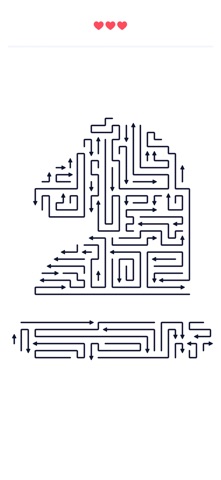
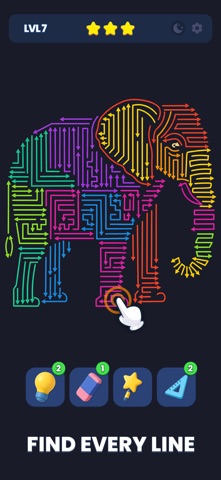
If you haven't played one yet: you get a board full of arrows and tap them in an order that gives each a free path off the board. It's arguably the most instantly readable core since Parking Jam, and the charts agree:
- Arrows – Puzzle Escape, from Tencent-owned Lessmore, broke into hypercasual's top 3 by downloads in December 2025 and finished June 2026 at #1 worldwide. The company put the word "original" in their app icon so players can easily know they were the first to market. Handy!
- Puzzle games with "arrow" in the title went from 9 in 2024, to 86 in 2025, to 871 in 2026. AppMagic's Arrow Puzzle tag passed 2,000 games, with 520+ releases in June alone.
- In Q3 2026, three arrow puzzles sat in the hypercasual top 10 by downloads, with Arrow Puzzle at 42M downloads, second only to Block Blast.
- The wave already iterates on itself: Cube Away 3D takes arrows into 3D and, by 2.5 Gamers' estimate, makes $160-200K a day, 60-75% of it from ads, with interstitials from level 4.



The arrow game that seems to have managed to monetise best is Lion Studios' Point Out: Color Escape. It reached 24M downloads and $11M in IAPs this YTD. That's about $0.46 RPD, against roughly $2 for Color Block Jam. In other words: the biggest download wave in puzzle has the thinnest IAP layer. But Lion added many ad placements, so expect actual RPD to be much higher. Massive reach, cheap installs. That's exactly the kind of core Moon Active's monetisation layer was built for: one that already pulls in players cheaply, with room for meta progression, events and offers on top.
Istanbul got there first
Of course it did. Grand Games, the Istanbul studio behind Magic Sort and Block Out, just started its fourth title, Maze Out. Its first session is in the video below. And the numbers already set it apart from the wave: $1.1M of IAP in October, two months after it started scaling, at $3.76 per download, which is about eight times Point Out's.


What Grand changed is the part that makes money. 2.5 Gamers' teardown points to a fail state the arrow template never had (a timer plus three lives) and boards that open section by section. This opens up new ways to monetise using a strict yet tempting loss condition. The result: an estimated $80-100K a day by mid-November.
Grand Games is taking Maze Out in a different direction from the rest of the wave: away from hybridcasual. At the time of writing, the game shows no ads at all, not even rewarded videos, while Point Out serves an interstitial after every level. IAP store intelligence shows Point Out still leads on lifetime IAP ($11.6M against $2.6M), even though Maze Out passed it in monthly IAP in October 2026 ($1.06M against $0.66M), but that gap is closing fast.
The IAP has something to sell into, too. Two months after its start, Maze Out already runs timed live-ops events side by side: Rocket Race pits five players against each other to clear five levels first, while Balloon Rise hands out chests on the way up a tower of levels.
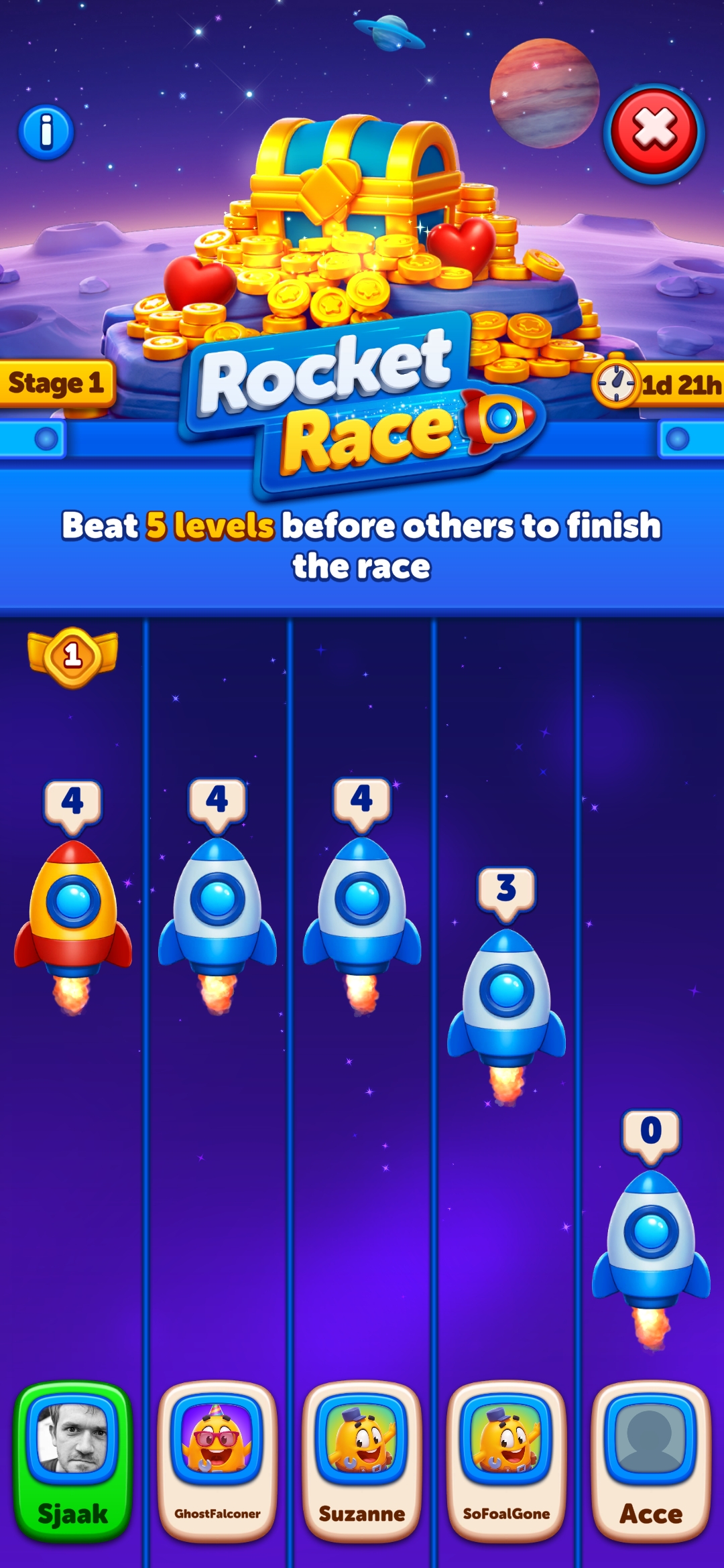
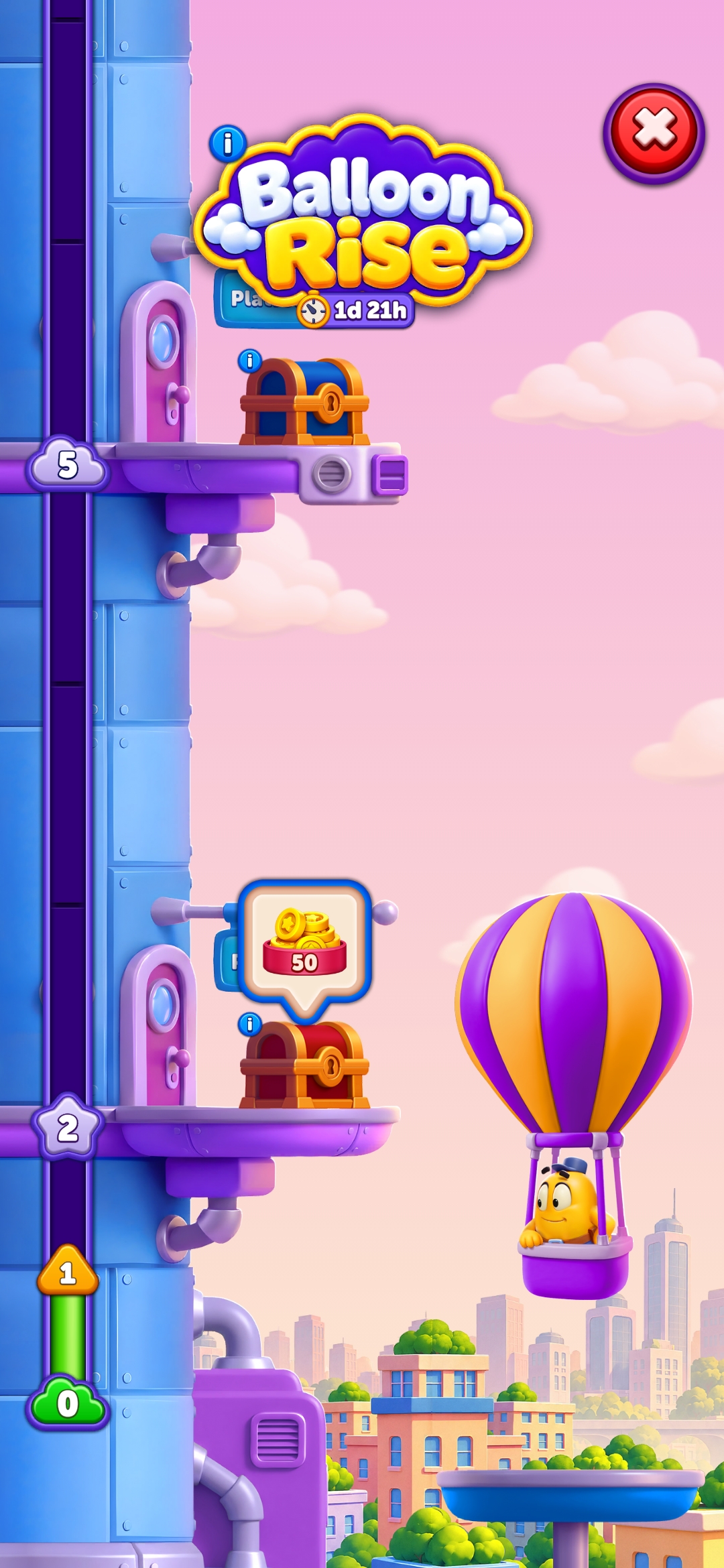
That's the template Moon Active has followed four times now: a Turkish or hypercasual studio proves the core, Moon Active arrives with the monetisation layer it built for Coin Master: meta progression, events, personalised offers and a live-ops calendar. Grand Games entering arrows is the signal that the core has graduated from ad-only to IAP-worthy, which is usually when Moon Active shows up.
Moon Active's Next Hustle?
This one likely going to happen, for at least 3 reasons: the wave is huge, the IAP layer is thin, and the Turks just proved it can carry one. So here's the bet:
- What: Moon Active soft-launches an arrow-removal puzzle (likely under another "Busters" name) on the same meta as Jelly Busters.
- When: by the end of Q2 2027. Given how the follow lag has shrunk, it may well be in a quiet soft launch already.
- How it'll differ: IAP-led, with ads in markets where IAP alone doesn't pay back, a collection or decoration meta, and live-ops events from day one. To beat Grand Games, it would need to top Maze Out's roughly $3.76 of IAP per download.
The risk is obvious: Moon Active could be too late. Only four of 2,000+ arrow games made 2026's hypercasual top 50 by installs, all from big studios that caught the trend early. But as Hole Stars showed, Moon Active doesn't need to win the download chart. It needs the best revenue per download, and that's a different race, and Grand Games is on that case already.
The Bottom Line
Let's wrap it up. If you only remember five things from this article, make it these:
- The casual fight moved from LTV to CPI. Everyone in casual knows how to monetise now. The winners are whoever can buy the next player cheapest and still monetise like casual.
- Turkey finds the cores, others scale them. Subsidised testing makes Istanbul the industry's R&D lab. Studios that can't match those costs don't need to win the prototyping race; they need to out-operate the winners.
- Cores are commodities, the monetisation layer is what lasts. Clones arrive within 30 days and hits decay within 18 months. What lasts is the meta, live-ops and offer machinery that can be moved from core to core. That's Moon Active's real product, and it has been since Travel Town.
- Arriving second only pays against an ad-monetised original. Royal Smash and Colony Flow out-earned their originators on IAP within months; Hole Stars needed a year to reach half of All in Hole's run rate. The difference was whether the first scaler had a monetisation layer of its own.
- Watch the arrows. The biggest trend in puzzle still has a relatively thin IAP layer. That gap is exactly what Moon Active's model is built to fill (if they can trump Grand).
Moon Active spent a decade proving you can turn a slot machine into a billion-dollar game. Fast-following hybridcasual puzzle titles is likely not the way to develop the next one but Zen Match scale is within reach, and 6 of those equal 1 unicorn.
When any studio with a puzzle template on the shelf can clone a core within 30 days, Moon Active is rarely the only follower in the auction, and against a strong original even its monetisation layer needed a year to reach half the leader's run rate. Then again, few companies bring a playbook this proven (or a UA war chest this deep) to the fight: it already turned a merge game, a tile matcher and a slot machine into top earners. Let's check back in a few months to see whether the arrows have found their path into Moon Active's portfolio.
Previous PostThree reasons for Monopoly Go's success